Download or print the complete fact sheet (April 2026).
Fast Facts on Charter Schools electronic sharing version (2 pages)
Fast Facts on Charter Schools print version (2 pages)
Recent Facts on Charter Schools in North Carolina
The 2025-26 school year opened with 213 charter schools located in 63 of North Carolina’s 100 counties. Charter schools served more than 153,480 students during the 2024-25 school year, representing 10.2% percent of North Carolina’s students. In 2024-25, a total of $1,182,929,082 was allocated to charter schools. This funding, again, will increase in 2025-26.
According to the 2024 Annual Charter Schools Report, since 1998, there have been a total of 94 charter closures. Three charter schools closed in 2023-24 and five closed in 2024-25. Seven new charter schools opened in 2023, ten opened in 2025, and seven are set to open in 2026.Since 1997 when charter schools were first introduced in North Carolina, the number of charter school applications submitted to the Office of Charter Schools has varied from a high of 71 (2013) to a low of six (2008). The State Board of Education has approved an average of 26% of each year’s applications.
For detailed information about all aspects of NC charter schools, read our report, NC Charter Schools: Undermining Quality Education for All.
What are Charter Schools?
Charter schools are generally tuition-free, independent public schools that are exempt from most of the rules, regulations, and statutes that apply to traditional public schools. In North Carolina, charter schools are primarily funded through state and local tax dollars. All charter school applications in North Carolina are authorized by the state. In some states, local districts or other entities authorize charter school applications.
Charter schools in North Carolina must have open enrollment and are not allowed to discriminate in admissions or be affiliated with a religion or religious group. In 2023, the NC General Assembly passed legislation (HB 291; Charter School Omnibus) allowing charter schools to charge tuition for out-of-state and foreign exchange students.
In NC, charter schools are exempt from many regulations required in traditional public schools, including some that ensure accountability, student accessibility, safety, and transparency in how tax funds are spent.
| Traditional | Charter | |
| Required to participate the NC accountability program | ✅ | ✅ |
| Required to administer EOG and EOC Tests | ✅ | ✅ |
| Required to follow the NC Standard Course of Study | ✅ | ❌ |
| Restrictions on school calendar and class size | ✅ | ❌ |
| Required to have 100% of teachers be licensed or pursuing licensure | ✅ | ❌ |
| Have required teacher workdays with prof. development opportunities | ✅ | ❌ |
| Required to provide free & reduced-price meals | ✅ | ❌ |
| Required to provide student transportation and follow safety standards | ✅ | ❌ |
| Governed by a citizen-elected school board | ✅ | ❌ |
| Required to make financial records public, accountable to taxpayers and county commissioners for use of local funding | ✅ | ❌ |
| Prohibited from being managed by for-profit companies | ✅ | ❌ |
| Must follow public bidding laws that protect how tax dollars are spent | ✅ | ❌ |
Brief History of North Carolina Charter Schools
The original North Carolina charter school legislation, House Bill 955 Charter Schools Act of 1996, was passed to authorize establishment of up to 100 charter schools. The legislation identified six purposes of charter schools in North Carolina:
- Improve student learning.
- Increase learning opportunities for all students, with special emphasis on expanded learning experiences for students who are identified as at risk of academic failure or academically gifted.
- Encourage the use of different and innovative teaching methods.
- Create new professional opportunities for teachers, including the opportunities to be responsible for the learning program at the school site.
- Provide parents and students with expanded choices in the types of educational opportunities that are available within the public school system.
- Hold the schools accountable for meeting measurable student achievement results and provide the schools with a method to change from rule-based to performance-based accountability systems.
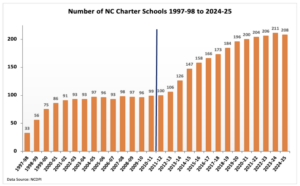
Thirty-four charter schools opened in 1997, and by 2010 there were 99. In August 2011, Senate Bill 8 removed the 100-school limit as well as limits on enrollment increases. In addition, Senate Bill 8 eliminated guardrails against schools being created to serve only specific subcategories of students (e.g., gifted students, students with disabilities, students of the same gender).
After the 100-school cap was lifted, the number of charter schools and students steadily increased. In 2012, there were 45,000 students enrolled in charter schools. By 2024-25 the number of charter school students had increased to more than 156,500.
The change in the percentage of students enrolled in various types of schooling (i.e., market share) in North Carolina over the past two decades reflects the trend of increasing charter school enrollment. The percentage of students in charter schools (orange) has increased from 1% in 2003-04 to 10% in 2023-24. The homeschooling population (yellow) has tripled, from 4% to 12% over the same time period, while the private school population (green) has increased 4%, from 6% to 10%.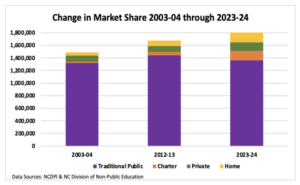
The 2023 legislative session expanded charter school funding and growth through two bills that became law after the state legislature voted to override former Governor Roy Cooper’s vetoes of both bills.
House Bill 219, Charter School Omnibus opened the door to massive charter school expansion; all except low performing charter schools are allowed to increase their enrollment maximums annually without review. Low performing schools are allowed to increase enrolment by up to 20% annually without review. All charters may also apply to become a regional or statewide virtual academy despite the poor track record of North Carolina’s current virtual charter schools.
Charter schools can establish enrollment preferences for students from specific preschool programs and students from military families. They are also allowed to charge tuition for out-of-state and foreign exchange students. In a huge windfall for charter schools and the companies that manage and lease buildings to them, county governments may provide capital funds to charter schools.
The second bill, House Bill 618, Charter School Review Board, stripped the State Board of Education (SBE) of its authority to approve/deny charter school applications and review charter school performance. The Charter School Advisory Board was renamed the Charter School Review Board (CSRB) and given the authority previously reserved for the SBE. The CSRB is staffed by charter school advocates and legislative appointees, which removes an important quality check on charter schools.
How Are Charter Schools Doing?
One way to evaluate the first legislative purpose, improve student learning, is to compare the student growth labels assigned to schools. As part of the North Carolina school accountability model, each school is assigned a student growth label to indicate whether students have “Exceeded,” “Met,” or “Not Met” achievement growth targets. These targets, based on students’ EOG and EOC test results, are intended to show how well a school contributes to student academic growth. Since 2016-17, the percentage of charter schools meeting or exceeding expected annual growth is lower than traditional public schools.
In 2023-24, sixty (30%) of North Carolina’s charter schools were identified as low performing, which means that the school received a D or F grade and growth label of “Met” or “Not Met.” This is a slightly lower percentage than traditional public schools (32%), but much higher than expected based on charter schools’ relatively low at-risk student population.
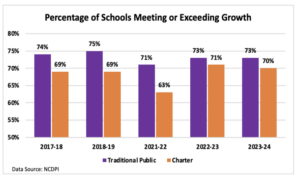
For many students, charter schools are not living up to their promise of providing a better education.
Another legislated purpose of charter schools was to provide learning opportunities for at-risk student populations. Students from economically disadvantaged (ED) backgrounds are an important at-risk student population. However, charter schools in North Carolina are failing to achieve their stated purpose; they enroll a much smaller percentage of ED students than traditional public schools. In 2024-25, 41% of charter school students were designated as economically disadvantaged compared to 51% of traditional public school students.
By enrolling fewer ED students than traditional public schools, charter schools also inflate their school performance grades. Data have shown that a school’s performance grade is strongly correlated with the percentage of ED students in the school, making the grade a better indicator of the wealth of students’ families instead of the quality of the school.
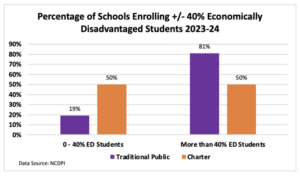
In 2023-24, none of the charter schools receiving an A and only 9% of schools receiving a B had more than 40% ED students. In contrast, 32% of the traditional public schools receiving an A and 44% of the schools receiving a B had more than 40% ED students. This data strongly suggests that traditional public schools are achieving better academic results for ED students than charter schools.
What Are the Concerns About Charter Schools?
Impact on local public school districts: Shifting funds from local public school districts to charter schools results in fewer resources at the local public school for staff, programs, and other basic expenditures. The state’s budget for charter schools has grown from just over $16 million in 1997 to nearly $1.2 billion in the 2024-2025 school year; most of that money would have gone to school districts for traditional public schools. Read more about money diversion and funding allocations for charter schools in our report, NC Charter Schools: Undermining Quality Education for All. 
Oversight: The Office of Charter Schools lacks adequate staff and a sufficiently rigorous process for evaluating applications and tracking charter success. Since 2014 when there were 8 staff and 147 charter schools, the number of staff has only grown to 10 while the number of charter schools increased to 208.
Reduced Public Input: Charter schools are not required to have publicly elected boards, or representation from the school community, which removes an important avenue for public/school community input into decisions regarding a charter school’s operation.
Student outcomes: The percentage of charter schools in North Carolina meeting or exceeding expected annual growth lags behind that of traditional public schools.
Racial isolation: A 2017 study by UCLA demonstrated that charter schools are more segregated than traditional public schools and the share of minority charter students has declined over time. In addition, the growing number of charter schools drive increasing amounts of segregation in traditional public schools, as middle class, mostly white students leave their district schools. Charter schools are required only to “make efforts” to “reasonably reflect the racial and ethnic composition” of the area where the school is located but there is no required mechanism for doing so and no consequence for failure.
In his 2018 report, Stymied by Segregation, Kris Nordstrom reports: “In 72 percent of North Carolina counties with at least one charter school, charter schools increase the degree of racial segregation in the district, as measured by the racial dissimilarity index.” In a follow-up report, Still Stymied: Why Integration Has Not Transformed North Carolina’s Schools, Nordstrom found that “Charter schools continue to exacerbate segregation and are vastly more likely to be segregated than traditional public schools.”
Public assets can become private assets: A failing charter can be taken over by a new entity, instead of being closed. The school’s assets could then be transferred to the new operator, not back to the state. The 2023 report by In the Public Interest, Real Estate and Charter Schools: A Growing Industrial Complex, documents the various means through which private real estate profits are fueling charter school growth.
Public funds can be used to enrich individuals and private charter operators: Because there are fewer regulations on how charter schools operate, funds can be used to lease services or facilities from charter operators (e.g. Torchlight Academy in NC) or their relatives and pay high administrative salaries while reducing student-facing educator salaries. See more in our 2025 report: NC Charter Schools: Undermining Quality Education for All.
Additional Charter School Legislation
In 2017, NC General Statute 115C-281.40 was implemented and states that a charter school may provide transportation to students enrolled in the school. A corresponding appropriation through S.L. 2017-57 provided more than $2 million each year to the Charter School Transportation Grant to fund transportation for students enrolled in a charter school with 50% or more of the student population qualified for the free/reduced lunch program. The 2021 budget specifies that a school may be reimbursed up to 65% of the transportation costs up to a maximum of $100,000 per school.
One of the most concerning bills to come out of the 2017-18 legislative session was House Bill 514, An Act to Permit Certain Towns to Operate Charter Schools (ratified as Ch. SL 2018-3 in 2018). This legislation applies to four municipalities within the Charlotte-Mecklenburg School District region: Cornelius, Huntersville, Matthews, and Mint Hill. It was treated as a local law and therefore did not require the governor’s signature.
The law permits these majority white suburbs of Charlotte to create their own charter schools. Further, these municipalities are permitted to restrict access to the schools to local residents only. In the budget amendments, a related provision (38.8) allows local municipalities to use (and raise) property taxes to fund schools. A major concern is that these charter schools will exacerbate existing segregation and inequality.
In April 2020, a lawsuit brought by the Lawyers Committee for Civil Rights Under Law along with several other parties including the Charlotte-Mecklenburg branch of the NAACP challenged the constitutionality of HB514. The lawsuit claims that the legislation violates the state’s constitutional guarantees of a uniform system of free public education and equal protection under the law. Because the communities named in HB514 have not yet actively pursued creating municipal charter schools, this lawsuit has not moved forward.
House Bill 618, Charter School Review Board, was introduced in April and passed in August of 2023. HB618 expanded the power of the CSRB by requiring that any rule pertaining to charters adopted by the State Board of Education (SBE) be first recommended by the CSRB. It reduced the number of voting members on the CSRB from 11 to 12 and removed the Superintendent of Public Instruction as a voting member. Most importantly, HB618 shifted the authority to approve new charters from the SBE to the CSRB, significantly diminishing the power of the SBE and granting unprecedented control to the CSRB.
House Bill 219, Charter School Omnibus, became law in August of 2023. HB219 allows charter schools to give enrollment preferences to any student who was enrolled for at least 75 consecutive days in a preschool program operated by an entity other than the charter school if the charter has an enrollment articulation agreement with the program operator. HB219 also authorized counties to provide funds to charter schools through direct appropriation (for certain specified purposes) and through leasing of real property. This provision expands the counties’ ability and that of charter school operators to enter contracts and make profit, something that is strictly prohibited in traditional public school contracts. HB219 also changed the formula for charter school funding to base the funds allotted on the number of students enrolled in the charter school rather than its ADM, diverting even more funds away from traditional public schools to charters.
Last revised: July 2025
References and Resources
Ayscue, J., Nelson, A.H., Mickelson, R. A., Giersch, J., Bottia, M. C., (2018). Charters as a driver of resegregation.
Brown, C. (2023, November 28th). Enrollment at traditional public schools declines for the first time since pandemic. EdNC.
General Assembly of North Carolina (1995-1996). House Bill 955/SL 1995-731, Charter Schools Act of 1996.
General Assembly of North Carolina (2010-2011). Senate Bill 8/SL 2011-164, An Act to Remove the Cap on the Number of Charter Schools.
General Assembly of North Carolina (2017-2018). House Bill 514/SL 2018-3. An Act to Permit Certain Towns to Operate Charter Schools.
General Assembly of North Carolina (2019-2020). Senate Bill 247. Charter School Study/Moratorium on Growth.
General Assembly of North Carolina (2023-2024). House Bill 219/SL 2023-107, Charter School Omnibus
General Assembly of North Carolina (2023-2024). House Bill 618/SL 2023-110. Charter School Review Board.
In the Public Interest. (2023). Real Estate and Charter Schools: A Growing Industrial Complex.
MyFutureNC. (2025). North Carolina Charter Schools Attainment Profiles.
Nordstrom, K. (2018). Stymied by segregation: How integration can transform North Carolina schools and the lives of its students.
Nordstrom, K. (2022). Still Stymied: Why Integration Has Not Transformed North Carolina’s Schools.
North Carolina Department of Administration (Non-Public Education), North Carolina Statistical Summary for Private Schools (2023-2024).
North Carolina Department of Public Instruction. (2024). North Carolina School Report Cards.
North Carolina Department of Public Instruction. (2025). Charter Schools.
North Carolina Department of Public Instruction. (June 2025). Report to the North Carolina General Assembly: 2024 Annual Charter School Report.
North Carolina Department of Public Instruction. (March 2025) Highlights of the North Carolina Public School Budget.
North Carolinians for Home Education. (2024). Number of Homeschools in North Carolina by County.