“There is immense power when a group of people with similar interests gets together to work toward the same goals.” ―Idowu Koyenikan
School Social Workers Psychologists, Nurses, and Counselors are often call “helping professionals” since their work is focused on providing the health and education services to improve the well-being of students. The NC Department of Public Instruction call these staff “Specialized Instructional Support Personnel.”
Download or print this fact sheet.
Specialized Instructional Support Personnel (SISP) are school-based professionals (social workers, psychologists, nurses, and counselors) who provide crucial health, social, emotional, mental health, and academic support to help all students overcome barriers to learning, ensuring they can succeed in school and life, working collaboratively with teachers and families. These staff support student success beyond classroom instruction by addressing the environment of the school itself as well as factors outside of the school. Children affected by social determinants of health (SDOH) that influence their pathway to educational, health, and career success. A school’s SISP can help address barriers that help all students learn, thrive, and grow.
The Center for Disease Control’s Youth Risk Behavior Survey Summary and Trends Report: 2013-2023 illustrates an alarming trend in youth mental health. While reported numbers of sexual partners, incidence of substance abuse and proportion of students reporting being bullied decreased, almost all other indicators of health and well-being in the report worsened significantly. These included experiences of violence, mental health, and suicidal thoughts and behaviors. These findings highlight the need for schools to have enough SISP to better address student needs.
In North Carolina, it is often difficult for school districts to find, hire and retain SISP because there are so many opportunities for higher salaries in the private sector. When school districts are unable to fund an appropriate number of SISP, the high student-to-staff ratios that result often lead to more job demands, stress and burnout. In some areas, there are fewer students graduating from SISP credentialing programs than there are jobs available. To address these issues, districts are adopting various strategies. For example, they contract for services with private service providers (e.g., psychologists) or other government agencies (e.g., county public health agency for nurses), and where possible, hire staff with provisional licenses.
School Social Workers
School social workers help promote students’ academic and social success. They support students through family counseling, individual or small group counseling, crisis intervention, advocacy, consultation, and screenings. School social workers help a variety of students including those in foster care, treatment programs, the juvenile justice system, or those affected by homelessness, violence and harassment, pregnancy, or at risk of dropping out of school. School social workers have three crucial roles:
- Provide “evidence-based education, behavior, and mental health services” to support academic and behavioral outcomes of a student.
- Cultivate “a school climate and culture conducive to student learning and teaching excellence,” which is established through acting in an advocacy role between a student, family, school, and community.
- Maximize accessibility “to school-based and community-based resources” by knowing which services are available within a community and making sure these services are accessible to everyone.
Research has shown that the presence of school social workers helps improve graduation rates, student mental and behavioral health, and reduces disciplinary issues and violence within schools.
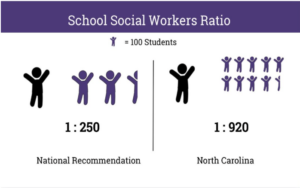
The recommended school social worker-to-student ratio is 1:250 with a lower ratio recommended when working with students with more intensive needs.
North Carolina’s current ratio is around 1:920.
The national annual mean wage for school social workers is $62,920. In North Carolina, the annual mean wage is $59,010. Many counties in North Carolina struggle to find qualified school social workers due to low pay and severe burnout. School social workers are paid according to the NCDPI State Salary Schedule.
To become a school social worker in North Carolina candidates must earn a bachelor’s degree in social work (BSW) in addition to completing required school social work-specific courses. However, most districts require candidates to have a master’s degree in social work (MSW). The candidate must also be licensed by the Department of Public Instruction. Currently, school social workers are paid according to the same salary scale as teachers, which does not provide additional pay for master’s degrees, creating another barrier for hiring and retaining school social workers. Several bills to increase pay for social workers to align with their degree status have been introduced in recent legislative sessions but have not yet become law.
School Psychologists
School Psychologists provide individualized counseling for students, develop schoolwide screening systems to identify which students or student groups need support, and lead schoolwide implementation efforts to help address mental health. School psychologists are also responsible for maintaining open dialogue with school staff, family members, and other professionals to help track student progress.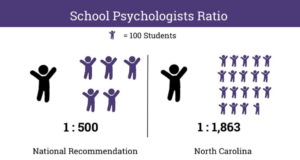
While school counselors act as the frontline mental health service for all students, school psychologists help at-risk students in addition to students with disabilities. School psychologists help students overcome trauma, grief, mental illness, stress, and other challenges they may face while trying to stay focused in school to become the best versions of themselves. Research on the impact of school psychologists has shown a wide variety of positive benefits including reduced high school dropout rates, improved student academics, fewer behavior problems, and improved teacher effectiveness.
The nationally recommended school psychologist-to-student ratio is 1:500. In North Carolina the ratio is 1:1,863 students.
Many psychologists don’t pursue this career because in North Carolina school psychologists are paid far below the national average salary ($70,090 compared to $93,610) and their educational programs are rigorous, requiring “intensive supervision and years of work” when compared to other psychology programs. School psychologists are paid according to the NCDPI State Salary Schedule.
To become a school psychologist in North Carolina, candidates must obtain an advanced degree in school psychology and also become licensed by the Department of Public Instruction.
School Nurses
School nurses conduct a specialized practice of nursing that protects and promotes student health, facilitates optimal development, and advances academic success. They are directly responsible for responding to health related emergencies and injuries, developing individualized health care assessments for students, overseeing any medication administration processes at schools, and developing disease control and outbreak responses within schools. They also provide screenings for conditions that could impact students’ education such as vision screenings, and act as the school’s community health liaison.
The impact a school nurse has on a student can be life changing. In North Carolina, around 14% of the K-12 student population receives services related to chronic health conditions such as diabetes, asthma, and severe allergies each year. In the 2023-24 school year, through case management services led by school nurses, 5,047 students received care which resulted in positive impacts on their health, including an 87% improvement in asthma, 87% in diabetes, and 92% in severe allergies.
The nationally recommended ratio of school nurses is one school nurse per school. In North Carolina, the ratio is 1:930, which results in many school nurses being required to serve more than one school.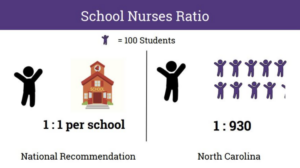
In the 2024-2025 school year, 59% of all school nurses in North Carolina served at one school while 33% served at two schools, 6% served at three schools, and 2% served 4-5 schools.
The annual average wage for school nurses nationally is $61,433, and just $58,389 in North Carolina.
To become a school nurse in North Carolina candidates must be licensed to practice as a Registered Nurse (RN) in North Carolina, obtain a Bachelor of Science in Nursing (BSN), and be certified by the National Board for Certification of School Nurses.
School Counselors
School Counselors focus on helping students succeed academically while in K-12 and after they graduate. They support and implement career awareness/readiness, college awareness/readiness, course scheduling, emotional intelligence, preventive mental health services for all students, and short term counseling which include referrals to long term support if needed. School Counselors examine the specific needs of a school, implementing specific initiatives and collaboration with teachers, administrators, and families.
Research on the impact of school counselors shows they can help lower student absenteeism, improve standardized test scores, prepare students for life beyond K-12 education, and close racial/ethnic, socio-economic, gender achievement gaps seen in schools. Many studies have shown the greatest effects when school counselors are staffed at recommended ratios.
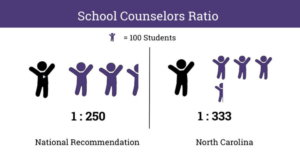
The nationally recommended school counselor-to-student ratio is 1:250. In North Carolina, the ratio is 1:333. The annual mean wage for school counselors nationally is $48,190 and the average is $45,790 for North Carolina school counselors. School counselors are paid according to the NCDPI State Salary Schedule.
To become a school counselor in North Carolina, candidates must obtain a Master’s Degree in School Counseling or a master’s degree in another area of counseling while taking school counselor-specific courses and be licensed by the Department of Public Instruction.
Conclusion
All SISPs are vital components of a healthy school. They help students with their mental, social, and physical health, while also preparing them for successful futures. Our SISPs are experiencing shortages that will have direct negative effects on students’ physical, mental, and behavioral health, their academic performance and their future outcomes. It is vital that SISPs get the financial, professional, and academic support they need, so our students get the help they deserve.
References
American School Counselor Association, Empirical Research Studies Supporting the Value of School Counseling.Center for Disease Control. (2025). Social Determinants of Health.
Center for Disease Control. (2025). Youth Risk Behavior Survey Data Summary & Trends Report: 2013–2023.
Monti, J. (2025, January 16th). North Carolina Social Work License Requirements and Programs: Become a Social Worker in NC. Psychology.org.
National Association of School Psychologists, School Psychologists: Improving Student and School Outcomes.
National Association for College Admission Counseling, Support for School Counselors.
National Board for Certification of School Nurses, Certification.
North Carolina Department of Health and Human Services. (2025). North Carolina Annual School Health Services Report Brochure (2023-24).
North Carolina Department of Health and Human Services, School Nursing Support.
North Carolina Department of Public Instruction. (2025). North Carolina State Salary Schedules FY 2024-25.
North Carolina Department of Public Instruction, Role of School Social Worker.
North Carolina Department of Public Instruction, Specialized Instructional Support.
Makor, K. L. (2025). Psychological Services in NC Public Schools, Becoming a Psychologist in North Carolina.
School-counselor.org, How to Become a North Carolina School Counselor.
Salary.com. (2025). School Counselor Salary in NC and School Counselor Salary in the U.S.
Salary.com. (2025). School Nurse Salary in NC and School Nurse Salary in the U.S.
School Social Work Association of America, School Social Work: Practice Model Overview.
Social Work Degrees, The Impact of Social Workers in Schools.
North Carolina Department of Public Instruction. Specialized Instructional Support Personnel, School Counseling and School Psychology.
United States Bureau of Labor Statistics. (2025). Occupational Employment and Wage Statistics.
Walkenhorst, E. (2022, April 7th). “NC education officials float school psychologist internship program, more funding for school buses.” WRAL News.
Last updated May 29, 2025