Overview of School Funding
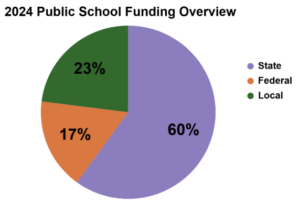
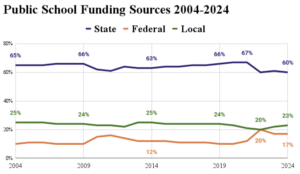
Across the United States, public schools are financed through a mix of federal, state, and local funding. In North Carolina, data from the North Carolina Statistical Profile shows that over the past 20 years, the state’s share of school funding has ranged from a high of 67% in 2020–2021 to a low of 60%, which is also the share in 2024. Local funding, the second-largest source, has reached its highest level of 25% multiple times over the years, dropped to a low of 20% in 2022, and stood at 23% in 2024. Federal funding, typically the smallest source of funding for districts, has ranged from a low of 10% to a high of 20% in 2022, and accounted for 17% in 2024.
Each funding source primarily supports different areas of education, though there is some overlap. However, the funding is also affected by decisions about how that money is spent. There are different positions at each level of government that play an important role in deciding how funds are used.
Local Level
At the local level, county commissioners are responsible for raising revenue and distributing funds, including all local money for education. They set property tax rates, determine how much of that revenue goes to schools, and approve funding for buildings, maintenance, and other capital needs. The local boards of education (school boards) identify funding needs each year and submit a proposed budget to the county commissioners who then decide how much county money will be allocated to education.
 When the state does not provide enough for teacher salaries and benefits, commissioners are often asked to fund local salary supplements to attract and retain staff. Without sufficient local support, districts may struggle with outdated facilities, limited staff, and fewer classroom resources. The local school board decides how funds are spent within the district. The school board hires the superintendent, sets district policies, adopts curriculum guidelines, and ensures schools comply with state and federal education standards. Board members also make key decisions about staffing, resource distribution, and balancing budgets when local funds fall short.
State Level
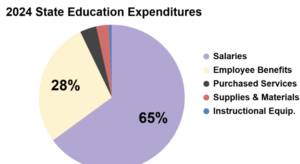
The state government provides the largest portion of education funding in North Carolina. In the 2024–2025 school year, the state contributed roughly $12.6 billion to K–12 education. State funds come from taxpayer dollars, such as income and sales taxes, along with non-tax revenue sources. Nearly 93% of the state funding is used for personnel, with most going toward salaries and employee benefits. The general assembly determines how much funding schools receive each year through the state budget, and the governor can propose changes and must sign the budget into law. The State Board of Education and the Department of Public Instruction oversee the distribution of funds to local school systems and ensure schools follow state policies. State leaders can also create new programs or raise educator pay, directly affecting the quality of education.
Federal Level
At the federal level, Congress and the U.S. Department of Education shape national education policy and ensure that all students are protected under federal law. Their role is to uphold equal access to education, safeguard students’ civil rights, and support programs that address the needs of disadvantaged groups. Federal funding reflects these priorities. 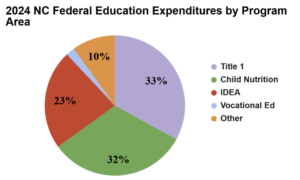
The NC DPI Public School Budget Report shows that during the 2024–25 school year, Title I accounted for about 33% of federal education funds and supported schools serving large numbers of low-income students. Another 23% went to the Individuals with Disabilities Education Act (IDEA) to provide services for students with disabilities, and 32% supported child nutrition programs. The Every Student Succeeds Act (ESSA) further guides how states track student performance and maintain accountability, while allowing flexibility in meeting those goals. In 2024, approximately 54% of federal funding was allocated to program personnel.
References
Highlights of the NC Public School Budget – NC DPI. (2025, March). https://www.dpi.nc.gov/documents/fbs/resources/2022-highlightspdf/download?attachment
North Carolina Public Schools Statistical Profile. (n.d.). https://apps.schools.nc.gov/apx212/f?p=145:1:::NO:::
The Facts on North Carolina Elections and Education. Public Schools First NC. (n.d.). https://publicschoolsfirstnc.org/resources/fact-sheets/
Download or print this fact sheet.
Last Updated: November 13, 2025