View a printable version of this fact sheet.
Overview
North Carolina’s school voucher programs date back to the 1950s, but the most recent versions launched in 2014. Since their launch, these voucher programs have siphoned more than $614 million away from public education. Eligibility for the voucher programs has expanded to the point where now all families, even the wealthiest, are eligible to receive tax dollars to pay for private school tuition. Prior enrollment in a public school is no longer an eligibility requirement, so families who have never sent children to public school are also eligible for state voucher funds.
The voucher expansions come at a time when North Carolina is experiencing a crisis in public education due to more than a decade of underfunding by the state. North Carolina’s legislators have shifted public funds to the private sector despite the state constitutional requirement that the General Assembly provide a “uniform system of free public schools.”
What Are Vouchers?
Private school vouchers have many names, including “scholarships” or “grants,” education savings accounts (ESA), and tuition tax credits. Regardless of what they are called, all voucher programs use public dollars to fund private schooling. Although in North Carolina, voucher funds come from the state’s general fund instead of the K-12 education fund, dollars that are allocated to vouchers could instead be put toward K-12 education. Vouchers divert scarce resources away from the public education system that serves nearly 90% of North Carolina’s children.
Nationally, there are three main categories of vouchers, though this list may change as privatizers seek new avenues to siphon money away from public schools. North Carolina’s vouchers include two of the three types: traditional vouchers and education savings accounts.
Traditional Vouchers

Traditional vouchers use public funds to pay all or part of the private school tuition for eligible students. Funds are sent directly from the state agency to the private school.
Many states apply family income eligibility requirements, limit the amount awarded for each voucher, require prior enrollment in public school or other student requirements, and/or impose conditions on the private schools that accept vouchers such as reporting or testing requirements.
North Carolina has no family income or prior school attendance requirements. The state’s voucher schools have no public accountability requirements.
Education Savings Account Vouchers
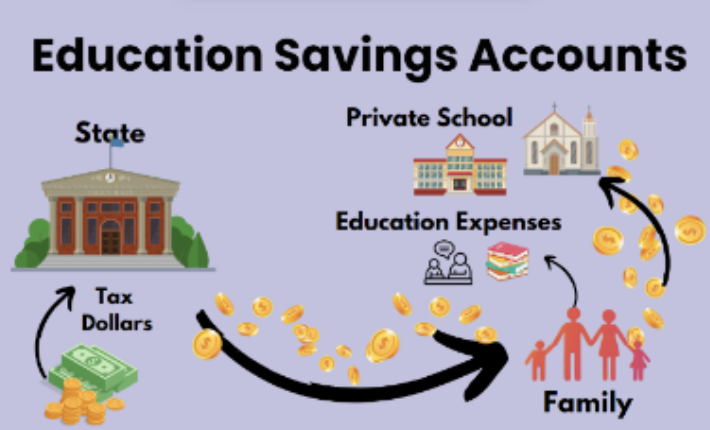
Education Savings Account vouchers deposit public funds into a personal account managed by a parent or guardian. The amount deposited is determined by the state’s specific requirements. The funds can be used to pay for private school tuition or other educational expenses such as educational technology, tutoring, coursework, transportation or other expenses approved by the state.
In North Carolina, through the ESA+ voucher program, private school tuition is sent directly from the state to the eligible private school.
Tax Credit Vouchers (no program in NC)

Tax Credit vouchers allow individuals or corporations to send a portion (specified by the state) of what they owe in taxes as a donation to a private organization instead of the state. The individual/corporation then gets a tax credit for the amount donated (does not have to pay the state).
The private organizations receiving the donations, often called school tuition organizations (STOs), serve as the administrator for the funds. Families apply to the organization to receive a voucher, and the organization sends funds directly to the private school.
Some tax credit or tax deduction programs bypass the STOs and allow individuals to deduct K-12 education expenses from their state income taxes.
See our fact sheet (https://wptest.publicschoolsfirstnc.org/resources/fact-sheets/the-facts-on-school-vouchers/) for more information about North Carolina’s voucher programs.