“Play gives children a chance to practice what they are learning.” Fred Rogers
Download or print this fact sheet.
The NC Pre-K program
Pre-kindergarten (pre-K) is an early childhood education program for children around 4 years old to attend before entering kindergarten. It is designed to help prepare children academically and socially for success in kindergarten and later years. North Carolina’s Pre-K Program, NC Pre-K (named More at Four from 2001 – 2011) was launched in 2001 to serve at-risk 4-year-olds with the goal of ensuring access to high-quality early learning across the state. The program requirements are built on the five developmental domains identified by the National Education Goals Panel as being critical to children’s success as they enter school.
- Approaches to play and learning
- Emotional and social development
- Health and physical development
- Language development and communication
- Cognitive development
The NC Pre-K program is provided through public schools, Head Start programs, and both nonprofit and private childcare centers. The NC Pre-K program requirements are designed to ensure that participating children receive a high-quality program in every local program throughout the state. For example, all NC Pre-K programs are required to have a 1:10 staff/child ratio. 
In its State of Preschool 2024 report, the National Institute for Early Education Research (NIEER) reported that North Carolina met 9 of 10 benchmarks on its Quality Standards Checklist. NC met standards in areas such as early learning development standards, curriculum supports, teacher degree requirements and specialized training, assistant teacher degree requirements, continuous improvements, class size, and staff/child ratio. The only area where NC fell short was in the number of hours required for professional development.
To be eligible for the NC Pre-K program, a child must be 4 years old by August 31st of the year they enter and must come from a family whose income is equal to or less than 75% of the state median. Up to 20% of children can come from a household with incomes above that level if the child falls in one of the following high-risk categories: developmental delay, identified disability, chronic health condition, or limited English proficiency. According to myFutureNC, in 2024, an estimated 57% of eligible 4-year-olds in NC were enrolled in NC Pre-K, placing 43% of NC’s eligible 4-year-olds at risk.
The Importance of Pre-K
The preschool years of a young child’s life are a crucial time in their social, emotional, and cognitive development. Participating in a high-quality early education program can greatly contribute to children’s later success, though experiences both before and after the pre-K years and the quality of the pre-K program heavily influence the effect of the pre-K experience. Decades of research have shown positive effects of high-quality pre-K programs.
Pre-K is a crucial stage in a child’s development
- Children who attend preschool gain confidence by learning the expectations and routines of school through close communication with other children.
- Pre-K is a place where children learn to socialize, make decisions, interact with others, and negotiate—all of which are important to child development.
- According to an annual assessment, NC Pre‐K students made significant gains from pre-K through kindergarten in language and literacy skills, math skills, general knowledge, and behavior.
Children who attend pre-K programs are more self-sufficient in the future
- Children who went to preschool were consistently employed, more likely to have full-time jobs, and less likely to rely on public assistance, resulting in overall positive future outcomes.
- Children who attend preschool are more likely to have a savings account, own a house, and a car.
Attending pre-K improves individual outcomes and reduces achievement and skill gaps
- Research shows that state pre-K programs have positive impacts on children’s cognitive skills, including both pre-reading and pre-math skills.
- Children who receive early intervention through pre-K are more prepared for school, which reduces the need for special education services.
- Enrollment in a high-quality pre-K program helps improve children’s reading proficiency by third grade. Proficiency in reading by third grade impacts a child’s entire educational experience and is correlated to graduating on time as well as attending college.
- Children who attended pre-K usually have a higher grade point average and are more likely to enroll in AP or IB courses and are less likely to be chronically absent or fail courses. They are also more likely to graduate from high school and attend college. Fundamental skills such as eye contact, self-confidence, work efficiency, attention span, and control of temper are developed during early childhood and are enriched in pre-K.
- Latino children and other dual language learners greatly benefit from NC Pre-K, making gains in the program at a greater rate than other students.
Pre-K is a good investment
- Children who attended pre-K are less likely to develop alcohol or drug problems, commit a felony, or go to prison. They are half as likely to be arrested.
- Every $1 invested in pre-K saves taxpayers up to $13 in future costs in incarceration, education, tax collections increases, and welfare.
- Enrolling a child in pre-K can increase parent earnings. A 2024 study by the National Bureau of Economic Research found a 21.% percent increase in parent earnings during the one- or two-year period when their child was of pre-K age. The gains in earnings persisted for at least six years.
- Some pre-K programs have been shown to offer an annual rate of return of 7-10%, a rate competitive with average stock market returns, but with other wide-reaching benefits.
- Investment in NC pre-K pays off by reducing the likelihood that a child will be placed into special education classrooms showing decreases of 29% in 3rd grade and increasing to 48% in 5th grade. Special education costs nearly twice as much as regular classroom education.
- Investing in NC Pre-K has positive effects for children not directly enrolled in the program.
- Child Care challenges are costing NC’s Economy an estimated $5.65 billion annually, in addition $1.36 billion in tax revenue from employee turnover and unplanned employee absences.
Pre-K Enrollment in NC
According to NIEER, in the 2023-2024 school year, 27,304 four-year-olds were enrolled in public preschool in NC, which represents a drop from 24% to 22%. Compared to states across the nation, NC ranks 28th for pre-K access and 19th for state spending on pre-K programs.
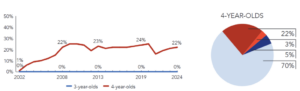
In addition to pre-K, 13,335 (3%) are enrolled in federally funded Head Start programs, and 11,919 (5%) in special education programs.
Combined, these enrollments represent 30% of North Carolina’s four-year-old children.
The percentage of children eligible for NC Pre-K who receive services is higher than the overall state pre-K enrollment average, with 57% of eligible students attending some form of NC Pre-K program. However, because the eligible children are from low-income households and are the children most in need of the social and academic supports provided by the high-quality programs, leaving 43% of the eligible children unserved is a powerful call to action.
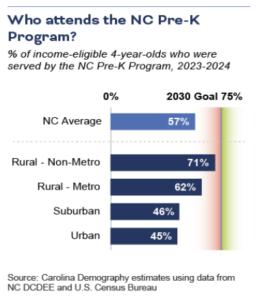
NC’s goal is to have 75% of eligible four-year-olds in each NC county be enrolled in NC Pre-K. This goal is aligned with the North Carolina Early Childhood Action Plan. Currently, only 37 out of 100 counties are meeting this enrollment goal.
Barriers to NC Pre-K Enrollment
In 2019 NIEER released a report looking at why eligible children were unable to enroll in NC Pre-K. They found that the overriding barrier to expanding access (i.e., enrollments) was that providers did not have the revenue or other resources to cover the cost of expansion. In NC’s funding model, the state pays about 60% of the cost, and the local community pays 40%. Many of the poorest NC counties don’t have the funds to cover their portion, so they end up forfeiting the state funds. Barriers faced by NC families include limited access to care and workforce shortages. According to the North Carolina Task Force on Child Care and Early Education report, 60% of child care center directors reported experiencing a staff shortage in 2024. This further strained the ability to expand pre-K offerings and maintain the program. Lawmakers proposed allocating approximately $13.3 million per year to expand NC Pre-K access, but this amount falls short of addressing the full scope of unmet need across the state.
While the pandemic initially impacted pre-K, national preschool enrollment has since recovered, though progress remains uneven across states. Many are still experiencing lower enrollment than before the pandemic. A significant change is that federal COVID-19 relief funding for preschool dropped by half in 2023-2024 compared to the prior year, and this funding source will no longer be available. Since the onset of the COVID-19 pandemic (January 2020), North Carolina has experienced a net loss of 9% of childcare programs, and 58% of early childhood educators stated that a program in their location closed in the past year.
NIEER Recommendations for Expanding Pre-K Access
A primary recommendation from the NIEER report for North Carolina to adopt a target of reaching 75% of eligible children statewide, with particular attention to underserved child populations and areas within the state where NC Pre-K services are least available has been adopted. Additional recommendations include:
- Offer financial incentives for four- and five-star private centers, already providing pre-K for 4-year-olds, to meet the higher-quality standards to become NC Pre-K sites, thereby allowing them to receive state funding. Increase reimbursement rates to account for rising costs and address specific barriers to expansion, including startup costs, thus incentivizing counties and providers to enroll at
- At least 75% of eligible children. Provide supplemental funds for NC Pre-K teacher compensation to achieve parity between private centers and public schools.
- Increase the artificially low allowable amount of funding that can be used to cover administrative costs.
- Explore mechanisms to better utilize childcare subsidy funds and NC Pre-K funds to serve the same child at private centers and public schools that provide NC Pre-K.
- Explore shifting NC Pre-K funding into the public-school funding formula in such a way that all children served can be jointly funded by state, local, and federal dollars.
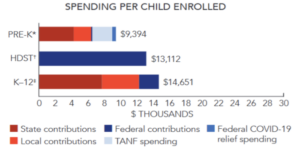
Funding for NC Pre-K comes from the North Carolina Education Lottery, federal funds, local funds, and state funds. State spending on NC Pre-K in 2024 was $115,259,501, with an additional $66,776,585 in Temporary Assistance for Needy Families (TANF) and $12,281,934 in federal CARES funds. State spending per child enrolled was $7,117, which is below the national state average of $7,888. All reported spending per child enrolled in NC in 2024 was $9,394.
The Leandro plan in North Carolina aims to provide a sound, basic education for all children by addressing eight key factors: monitoring compliance, adequate funding, qualified educators and leaders, quality early education, support for high-poverty schools, accountability, and local school improvement. You can read more about Leandro plan here.
If the funding designated for pre-K in the Leandro plan were fully allocated, NC would be able to meet the needs of many more of its children. However, recent budgets and House and Senate proposals for the 2025–27 budget, lack sufficient funding to expand NC pre-K opportunities
Expanding Access Through Family Child Care
The Enriching Public Pre-K Through Inclusion of Family Child Care (EPIC FCC) Initiative, launched in 2024 by Home Grown and NIEER, aims to expand access to high-quality pre-K by integrating family childcare providers into public pre-K systems. The initiative supports state and local governments with $25,000 planning grants, expert guidance, and access to a learning community that helps with program design, equitable financing, and more. Benefits of EPIC FCC include increased access for children in rural or underserved areas here in NC, culturally responsive care, and supporting family childcare providers who are often excluded from public early education initiatives. Funding for EPIC FCC currently comes from the Annie E. Casey Foundation and the Esther A. & Joseph Klingenstein Fund.
North Carolina desperately needs adequate levels of funding to cover the cost of delivering a high-quality pre-K program for all children in need.
References and Resources
Barnett, S., and Kasmin R. (2018). Barriers to Expansion of NC Pre-K: Problems and Potential Solutions. New Brunswick, NJ: National Institute for Early Education Research. Retrieved June 30, 2025 from https://nieer.org/sites/default/files/2023-07/nieer_north_carolina_2019.pdf
Bill Summary for H 715 (2025-2026). Legislative Reporting Service. (2025, April 4). https://lrs.sog.unc.edu/billsum/H-715-2025-2026
Dodge, K. A., Bai, Y., Ladd, H. F., & Muschkin, C. G. (2017). Impact of North Carolina’s Early Childhood Programs and Policies on Educational Outcomes in Elementary School. Child development, 88(3), 996–1014. https://doi.org/10.1111/cdev.12645
Dukes, K. (2025, June). New guidance for integrating family child care homes into public preschool. EdNC. https://www.ednc.org/06-04-2025-new-guidance-integrating-family-child-care-homes-into-public-preschool/
Friedman-Krauss, A. H., Barnett, W. S., Hodges, K. S., Garver, K. A., Duer, J. K., Weisenfeld, G. G., & Siegel, J. (2024). The State of Preschool 2024: State Preschool Yearbook. New Brunswick, NJ: National Institute for Early Education Research. Retrieved from https://nieer.org/sites/default/files/2025-04/2024NIEERStateofPreschool-1.pdf
Gray-Lobe, G., Pathak, P., & Walters, C. (2021). The Long-Term Effects of Universal Preschool in Boston. https://doi.org/10.3386/w28756
Grown, H. (2024, July). Announcing the enriching public pre-K through inclusion of Family Child Care (Epic FCC) initiative. Home Grown Child Care. https://homegrownchildcare.org/announcing-the-enriching-public-pre-k-through-inclusion-of-family-child-care-epic-fcc-initiative/
Hayward, G., Muschkin, C. G., Ladd, H. F., & Sauval, M. (2025, February). NC Pre-K has School-Wide Benefits. Duke University, Duke Center for Child and Family Policy. Retrieved from https://childandfamilypolicy.duke.edu/wp-content/uploads/sites/2/2025/02/NC-PreK-has-School-Wide-Benefits.pdf
Heckman, J. J., Moon, S. H., Pinto, R., Savelyev, P. A., & Yavitz, A. (2010). The rate of return to the Highscope Perry Preschool Program. Journal of Public Economics, 94(1–2), 114–128. https://doi.org/10.1016/j.jpubeco.2009.11.001
Hernandez, D. J. (2012). Double jeopardy: How third-grade reading skills and poverty influence high school graduation. The Annie E. Casey Foundation. Retrieved from https://www.publicschoolsfirstnc.org/wp-content/uploads/2022/05/2012_AECF-DoubleJeopardy-2012-Full.pdf
McCormick, M. (2025, May). Spotlight on evidence: The role of curricula and professional learning in improving Pre-K Quality. Overdeck Family Foundation. https://overdeck.org/news-and-resources/article/spotlight-on-evidence-the-role-of-curricula-and-professional-learning-in-improving-pre-k-quality/
Muschkin, C. G., Ladd, H. F., & Sauval, M. (2024). Pre-K enrollments and teaching environments in North Carolina elementary schools. Children and Youth Services Review, 164, 107832.
My Future NC (2024). NC Pre-K Enrollment. My Future NC. Retrieved June 30, 2025 from https://dashboard.myfuturenc.org/academic-readiness/nc-pre-k-enrollment/
National Institute for Early Education Research. National Project supports state and local leaders with inclusion of high quality family child care in Pre-K Systems.. (2024, November). https://nieer.org/research-library/national-project-supports-state-local-leaders-inclusion-high-quality-family-child
North Carolina Division of Child Development and Early Education. (2024). North Carolina Pre-Kindergarten (NC Pre-K) Program Requirements and Guidance. Retrieved June 30, 2025 from https://ncchildcare.ncdhhs.gov/Portals/0/documents/pdf/2/2024-2025_NC_Pre-K_Program_Requirements_and_Guidance_Final_Rev__September_2024.pdf?ver=DKUNM0a0kqSj2iGkloVrcQ%3d%3d
North Carolina Division of Child Development and Early Education. (2024). NC Pre-K North Carolina Prekindergarten Program. Retrieved June 30, 2025 from https://ncchildcare.ncdhhs.gov/Home/DCDEE-Sections/North-Carolina-Pre-Kindergarten-NC-Pre-K
North Carolina Task Force on Child Care & Early Education. (2025, June 30). North Carolina Task Force on Child Care & Early Education Interim Report. North Carolina Department of Commerce. Retrieved July 3, 2025 from https://www.commerce.nc.gov/reports-policymakers/other-reports/report-nc-task-force-child-care-early-education-june-2025/open
Pre-Kindergarten Task Force. (2017). The current state of scientific knowledge on pre-kindergarten effects. Duke University. Retrieved from https://www.brookings.edu/wp-content/uploads/2017/04/duke_prekstudy_final_4-4-17_hires.pdf
The Leandro plan. Communities for the Education of Every Child NC. (n.d.). https://everychildnc.org/leandro-plan/
Weisenfeld, G. G. (2021). Impacts of Covid-19 on Preschool Enrollment and Spending. New Brunswick, NJ: National Institute for Early Education Research. Retrieved June 30, 2025 from https://nieer.org/wp-content/uploads/2021/03/NIEER_Policy_Brief_Impacts-of-Covid-19-on_Preschool_Enrollment_and_Spending_3_16_21.pdf
Last updated July 11, 2025
Visit our website for more information: www.publicschoolsfirstnc.org